Every HVAC caller deserves a clear next step.
When the office is busy or closed, the right first response captures the essentials, follows your approved routing rules, and leaves the hard judgment to your people.

Still a clear path forward.
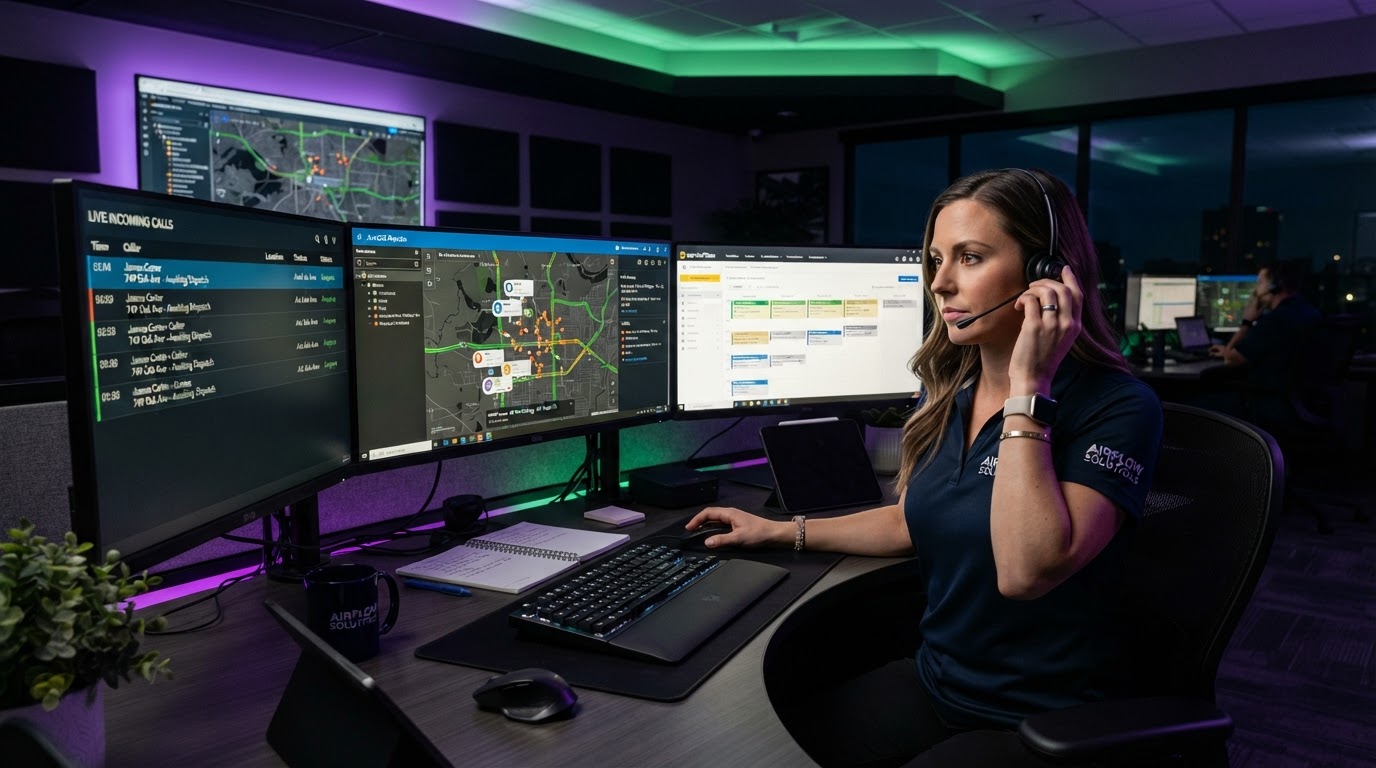
Incoming calls auto-triage, record structured intake, and alert on-call dispatch.
HVAC calls rarely arrive at convenient times.
A caller may need service, a reschedule, a callback, or a clear answer about what happens next. When no one can answer quickly, your team is left piecing the story back together later.
Interrupted technicians
Field teams are asked to switch context while serving the customer already in front of them.
Thin intake notes
Voicemail rarely includes the contact details, address, timing, and call type someone needs.
Slow callbacks
Even a good team looks inconsistent when the customer does not know what happens after the ring.
A dependable front door,
with a human backstop.
Good automation is not a technician in disguise. It is a carefully bounded process that makes every routine caller easier for your team to help.
Capture the essential details
Name, callback number, address, high-level issue, and timing preference—before a busy office has to reconstruct the call from voicemail.
Classify the call under your rules
New service request, maintenance question, existing appointment, billing concern, or a path that needs a person right now.
Route to the approved next step
Your own service-area, scheduling, and escalation rules determine what happens next. The system does not invent availability.
Keep judgment where it belongs
Human HandoffTechnicians, dispatchers, and office staff handle safety, technical, upset-customer, and exception decisions with the context already captured.
One reliable first step. Different approved paths.
No cooling after hours
Calm first response, safety-language recognition, structured service intake, and an approved handoff.
Existing appointment needs help
Identity and callback details captured so the scheduling team can confirm the next available option.
Maintenance request
Routine request details gathered without pulling a technician away from a job site.
Office or billing question
The caller gets a clear route instead of being passed around or forced to start over later.
Start with your real call flow—not a generic demo.
In a focused 15-minute review, we map what happens when the first person cannot answer, find the likely lead-leak points, and outline a practical first-response and escalation workflow.
Map the current process
What happens when the first person cannot answer?
Identify the leaks
Where do calls, callbacks, and notes stall?
Define the approved flow
Decide what can be captured, routed, scheduled, or escalated.
Tell us where calls get stuck.
Automation earns trust by knowing its boundary.
It identifies its role
Any deployed automated first response identifies its automated role and follows the routes your team defines.
It does not diagnose
Equipment diagnosis, repair instruction, pricing, and technician judgment stay with qualified people.
It does not improvise safety
Safety language follows your approved escalation process and must never delay immediate emergency services.
A person remains reachable
Urgent, complex, uncertain, and dissatisfied callers have a defined route to a human.
What operators usually ask first.
Stop asking your team to remember every missed call.
Give callers a clear first step and your staff the right context to take over.